Cluelessness and Education Policy
In 2013 the Cameron Government published a national curriculum that mandated all children aged 5 to 16 in local-authority-maintained schools in England must learn to code. The skills children would learn advanced with age. In Key Stage 1 children were expected to “Create and debug simple programs”. By Key Stage 2 they should be taught to “design, write and debug programs that accomplish specific goals” and “use sequence, selection and repetition in programs”. In KS3 students were taught to “use 2 or more programming languages, at least one of which is textual, to solve a variety of computational problems”, and to “understand simple Boolean logic (for example, AND, OR and NOT) and some of its uses in circuits and programming”. (National Curriculum in England: Computing Programmes of Study)
By 2023, a decade later, LLMs were first becoming proficient in coding. Today coding is one of the fields most at risk of becoming redundant due to advancements in AI. Coding is likely to continue to lose value as a skill, as LLM models continue to become more proficient. This development makes much of the resources allocated to its teaching and promotion decreasingly worthwhile.
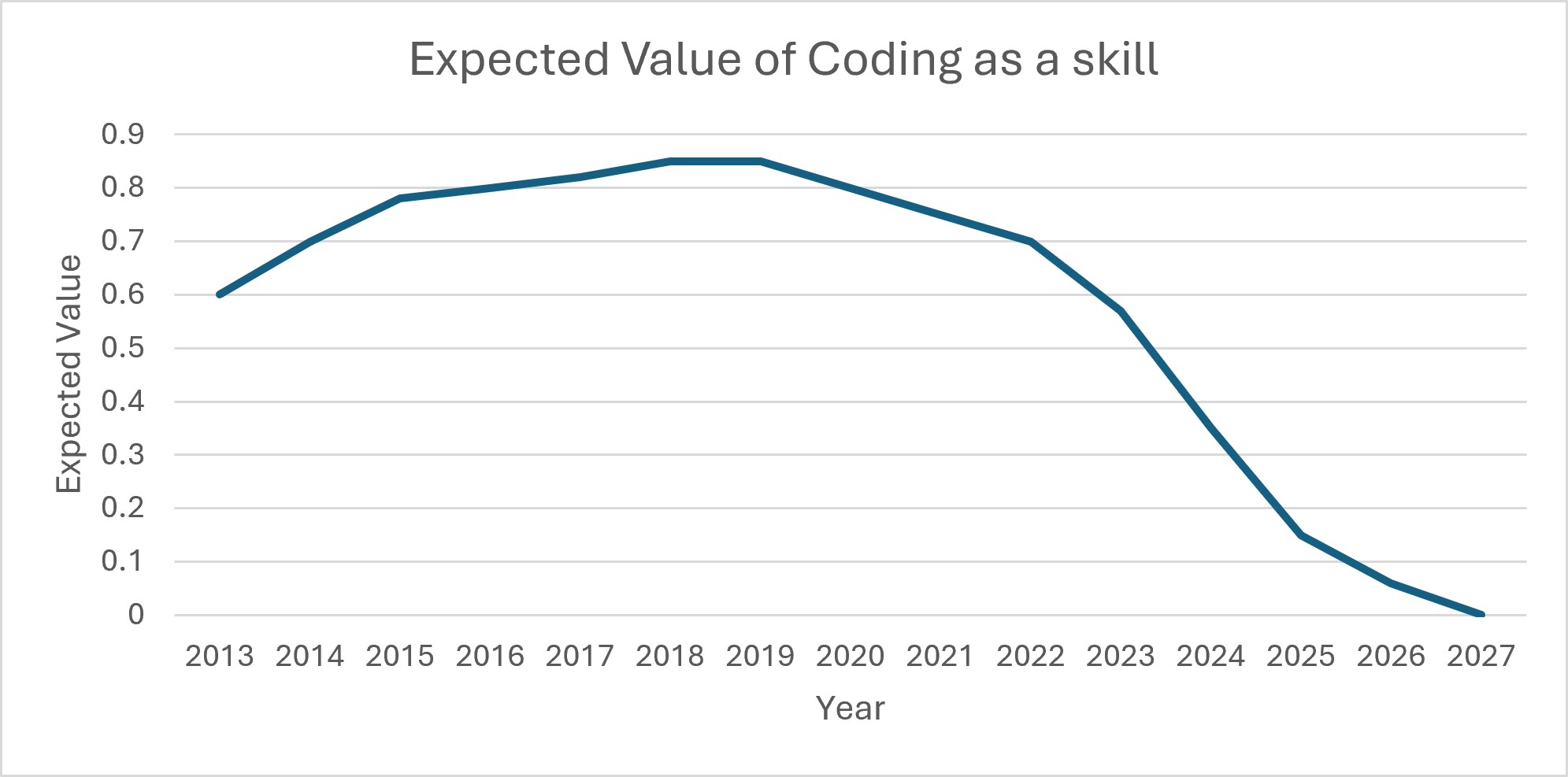
Did the Department for Education get it wrong in 2013?
The 2013 national curriculum fell victim to a much-examined problem in consequentialism: the problem of uncertainty. This problem attacks consequentialism on the grounds that the future is uncertain. The critique focuses on the flaws in making decisions aimed at bringing about the best consequences when the future is uncertain and it is difficult, or even impossible, to know the consequences decisions will have in the future. The problem of uncertainty is commonly raised as an objection to consequentialism both in personal ethical decision-making and policy decision-making.
The scope of this problem stretches far beyond education policy and curriculum setting. It is a problem any policymaker must encounter and grapple with if they are to craft effective public policy.
Good government policy is written by thoughtfully considering the context, the evidence, and possible futures, taking all of this information into consideration, then producing policy that will lead to the best outcomes for the state, citizens and stakeholders around the world both presently and in the future.
Generally, the longer the time horizon of a decision, the more vulnerable it is to the problem of uncertainty. We may be fairly sure about the right action to take for the next three months, but far more uncertain about the next ten years. Education policy is inherently vulnerable to the problem of uncertainty. Education policy is always future-oriented and so is forced to grapple with long-term thinking and uncertainty more than other areas of policy often do, even if they should be similarly oriented towards the future.
Education policy is also a deeply sensitive domain as decisions made are often identity-forming. This means that DfE policy decisions can often have lifelong and intergenerational consequences because identity is formed in and through education, and this identity will impact every part of a person’s life as well as the lives of people connected to that person. Schools teaching a curriculum that provides obsolete skills will produce destitute individuals who feel they have no ability nor future in a context they were not prepared for. This is disastrous not only for these individuals but the broader social context and state which these individuals constitute.
Given this, when we ask the question, “Did the DfE get it wrong when they promoted coding in the 2013 national curriculum?”, we may expect the answer to be a firm “yes” because coding is an increasingly obsolete human skill. The value of this skill has greatly diminished along with the hours spent teaching it. Those who undertook vocational and academic training are looking into an increasingly destitute future unless they can pivot into another field. All of this points to a pretty clear misstep by the criteria given above.
Despite this, it is not clear we can confidently assert the Department for Education made a mistake. While the value of coding is now diminished, the simple fact that future outcomes defied expectations and predictions at the time is an insufficient basis for assigning failure. The failure of predictions ought to be the foundation of criticism and forthcoming consideration about future policy decisions. It should prompt examination as to what caused a model to produce inaccurate expectations or failed predictions. However, it is not a mistake in itself to have predictions and reality vary.
The difficulty of knowing the uncertain future should prompt retrospective, descriptive analysis of the policy, context and variance between the predicted future and the future which came to be. Descriptive reflexive practice is both more beneficial and more appropriate than normative condemnation or blame, insofar as all the available information was put to good use and reasonable conclusions were reached given the best available evidence.
One reason against engaging in normative condemnation of policy based on its variance from future outcomes is that doing so would be epistemically arrogant. It is presumptuous to conclude the rightness or wrongness of a policy and its consequences in history while you yourself are a participant and a part of that ongoing history.
Today we can consider current AI capabilities, along with trends in development and accessibility, to argue that the prioritisation of coding in 2013 was a mistake. Yet to do so we must recognise the fallibility of our own position in history and our own vulnerability to the problems of uncertainty. In a year from now, the technologies that have largely devalued coding could cease to exist, whether through protectionist policies of the sort we already hear murmurs of, such as the US restricting Britain’s access to some models, or any number of other causes. In such a case the value of coding could be redeemed, along with the value of the 2013 national curriculum.
The above is just one possible instance of the uncertainty we are faced with when evaluating policy decisions. There could be any number of seemingly unrelated or incomprehensible consequences entailed in or flowing from any policy. As the time horizon extends, the number and degree of possible variance between the consequences forecast by models and the realised future broadens too.
This deeply troubling problem is what philosopher James Lenman refers to as the problem of cluelessness. In his 2000 essay, Consequentialism and Cluelessness (/uploads/8/8/1/7/88177244/cons_and_cluelessness_lenman.pdf" target="_blank" rel="noopener noreferrer">PDF Link).
In the essay Lenman communicates the problem of cluelessness as a problem greater than the problem of uncertainty. He claims it is not just that we are uncertain about the consequences our policies may have, but that we are utterly clueless and unable even to evaluate decisions because of this cluelessness. Through a number of illustrations Lenman highlights the unique issues presented by the problem of cluelessness. Two poignant examples will communicate the problem here.
First is Benjamin, a financier who aims “to maximize the aggregate financial gains over losses of all the people affected by it.” He has a decision in front of him and is told by an omniscient force that his decisions between action X and Y will have profound consequences in which “billions of people are either better or worse off in monetary terms than they would be otherwise.” He does not know whether action X or action Y will result in the better or worse consequences for billions of people.
The omniscient force then tells Benjamin that one of the consequences of action X will be “that Mrs Jennifer Lawson of 17 Cedar Row, Macclesfield, will be £100 better off than otherwise” but does not give him any further information on whether X or Y has the positive or negative impact on billions of people. It could be that in choosing action X Mrs Lawson is made £100 richer, but billions face destitution. Or that in action Y Mrs Lawson loses out on the £100 but billions are enriched. The fact is that the information Benjamin possesses is so limited and small relative to the consequences of the decision that he has no real ability to make a well-justified decision.
In a similar way, policymakers have information which may be very well researched and much richer than the information Benjamin possesses, yet comparatively both Benjamin and the policymaker are equally out of their depth. All things considered, they are equally clueless about the future consequences of their actions.
Another example from Lenman’s paper is Richard the Barbarian who is raiding a village in central Europe long ago. When raiding one particular village Richard makes the decision to spare a young woman, Angie. In this moment, anyone would consider the sparing of an innocent life to be a good decision, yet Angie is the great-great-great (and so on) ancestor of Adolf Hitler.
By taking her life Richard could have prevented the atrocities of the Second World War. Or, by taking her life, any number of other consequences could have flowed, potentially leading to a future in which the scale of atrocities committed in the Second World War are doubled or tripled. The possible outcomes are utterly unknowable; we are clueless.
Lenman’s point is that our actions and policy decisions will have consequences so far into the future, and on grounds of information that we cannot possibly know, even contrary to our best judgement, that it is impossible to make decisions and evaluate them on the basis of their consequences.
“The worry is not that our certainty is imperfect, but that we do not have a clue about the overall consequences of many of our actions. Or rather, for let us be precise, a clue is precisely what we do have, but it is a clue of bewildering insignificance.”
This problem plagues not only long-term future-facing public policy, nor even all of public policy, but all decision-making. It is a deeply challenging concern and throws a stick in the spokes of policy crafting as we are not, in Lenman’s conception, even able to know what consequences will flow from actions, so we certainly cannot evaluate them.
Is Public Policy Dead?
In the face of this grave problem, is future-facing public policy a pointless pursuit? Is there any reason to try to understand and produce good consequences if we cannot possibly know what the outcomes will be in a thousand years’ time? Are we doomed to be clueless as to the consequences of our decisions?
No. While we cannot have perfect knowledge of the outcomes of policy decisions, especially as those consequences ripple farther into the future, there is no reason to accept that we need, or even ought, to know all the consequences that will flow from a policy forever into the future. This is simply the wrong frame of analysis for public policy.
While critique of our policy-producing practices is valuable, and the problems of uncertainty and cluelessness offer important contributions and challenges to think about, they do not undermine the project of producing future-facing public policy. The production of public policy in an imperfect epistemic context is a reality we must contend with.
To riff on Sartre, we have no choice but to produce policy. We are condemned to do our best for the people, the state and the world of today and the future.
What valuable insight can we take from the problems of uncertainty and cluelessness?
Epistemic Humility
First, we can embrace an attitude of epistemic humility, something so often under-appreciated in a divisive political environment. Lenman himself points to this, though he is unsatisfied with mere epistemic humility. He argues that when making decisions in the context of cluelessness:
“You should be immensely humble about whether any of this does any good overall.” (Pp. 367-368)
Maintaining an open mind to the possible wrongness of assertions, conclusions and predictions, even when they are strongly supported by the available evidence and models, may allow for a better appreciation of the gravity of the problems of uncertainty. Such an appreciation will be reflected in more cautious approaches that avoid pitfalls and missteps where it is possible to do so.
This argument grants that there are still some missteps that it will be impossible to foresee, or so counter-intuitive and unlikely to come about, such as Richard foreseeing the actions of Angie’s far-off ancestor, that taking actions to avoid these far-fetched pitfalls would itself likely result in a higher rate of missteps and lead to lower overall accuracy of predictions, alongside lower attainment of immediate and certain goods.
If Richard annihilated every village he came across, he would have killed Angie and prevented her ancestor from wreaking havoc and misery on the world centuries later, but every other innocent he killed in addition to Angie was nevertheless a misstep and was, in the immediate context, the wrong decision to make.
Importantly, epistemic humility does not mean simply rolling over, nor does it entail meekness in the face of a political opposition that is not exhibiting the same epistemic humility. It is always a risk in embodying a virtue that your opposition may gain an advantage over you by not embracing it.
You cannot play Monopoly with a cheat; you cannot play football if the other team picks up the ball and carries it. A commitment to epistemic humility in policy writing includes not only a commitment to epistemic humility in your own policy writing but a commitment to enforcing that humility universally.
If the other team picks up the football, the solution is not to allow it out of a commitment to humility, nor to abandon your own commitment to the rules and join in by picking up the ball yourself. The correct action is to enforce the standard firmly, ensuring epistemic humility is rightly seen for the virtue it is and is embraced by all parties playing the game.
Rather paradoxically, if you show epistemic humility about the value of epistemic humility, then you will end up without epistemic humility in your politics. It is often only the commitment to a virtue which assures its value. It is vital to ensure commitment to this virtue if it is to be preserved and continue to hold as a virtue.
This is not to say the virtue of epistemic humility is wholly self-generated in its acceptance and preservation as a virtue. Allow the virtue to slide and you will reap the consequences and discover why epistemic humility was such a valuable virtue.
Valuable things often require maintenance and work to recognise and preserve their value. It is vital that epistemic humility is shown about all things except epistemic humility itself. It is a terrible error to be meek in defending it against those who have not done the work to recognise its value or who are disinterested in its preservation for short-term gain or otherwise. Paradoxical as this is, axiomatic principles often reduce to brute fact statements and can be judged by the fruits they bear rather than by a priori reasoning.
“Diversity is our Strength”
As exhausted as the phrase is, diversity and breadth in policy crafting are good responses to uncertainty and cluelessness concerns. By diversifying policy to ensure a broad scope, covering a wide range of possibilities and many potential futures, and embracing as little specialisation as possible given the context, we can move towards better policy outcomes in the future.
This is much the same as diversifying an investment portfolio and should be embraced in policy for the same reason: the unknowability of the future. While the 2013 national curriculum’s assessment of the importance of coding is now out of step with contemporary realities, much of the curriculum remains relevant and valuable today precisely because it was broad and diverse.
(://www.gov.uk/government/publications/national-curriculum-in-england-computing-programmes-of-study/national-curriculum-in-england-computing-programmes-of-study" target="_blank" rel="noopener noreferrer">National Curriculum in England: Computing Programmes of Study)
Alongside the prescription to learn code were prescriptions that students in Key Stage 1 should “understand what algorithms are [and] how they are implemented as programs on digital devices.” In Key Stage 2 it was expected students could “understand computer networks, including the internet; how they can provide multiple services, such as the World Wide Web, and the opportunities they offer for communication and collaboration.” At Key Stage 3 children should “understand several key algorithms that reflect computational thinking.”
These areas are still hugely important and applicable to a contemporary context. Because the national curriculum was varied and promoted a diverse range of topics and areas of learning, while some avenues did not have long valuable futures, others have remained relevant.
A scattergun approach, albeit a sophisticated and refined approach led by the best available evidence, ensures the best chances of providing value into the future and overcoming uncertainty, not because any one part of the approach has avoided the problem of uncertainty but because the more diverse the curriculum, the less likely it is that all themes will become irrelevant and outdated.
The greater the diversity, the greater the chance that one or more elements will be more valuable and relevant than was reasonable to conclude from the available evidence when the policy was formed.
A diversified approach both mitigates and reduces the likelihood of the worst scenario (pointless and irrelevant decisions) and increases the possibility that we may create policies that are more relevant and advantageous to the future than we could have predicted.
Of note here is the contemporary problem universities are facing regarding shrinking funding and thus shrinking staff and course offerings. While detestable anti-intellectual and anti-academic sentiment is on the rise and perhaps motivating much of the press surrounding this issue, there is a legitimate need to recognise shifting market conditions and to follow market forces in some instances, while recognising occasions in which something valuable ought to be protected above and beyond the market value of a skill. But that is for another essay.
Conclusion
Suffice to say, diversification guards us against the worst outcomes and increases the likelihood that we make effective and even good decisions into the future. While we ought to be gravely concerned by the problems of uncertainty and cluelessness, policymaking is an inescapable duty and privilege. We must take the best, most careful steps in fulfilment of this duty.
The necessity of adopting a future-conscious approach is straightforwardly apparent in education policy but should be recognised for its value and importance in all fields of public policy. Housing, urban planning and development, climate policy and environmental policy are all similarly well suited to long-termist thinking.
However, the problems of uncertainty and cluelessness should provoke deeper thinking about the far-reaching consequences of all public policy and demand that we deploy both epistemic humility and thoughtfulness about the scope and diversity of potential futures for which policy accounts.