With careful forethought and planning, decisions which come at very little cost today can be immensely valuable in the future.
Long-termism is a contemporary field of Philosophy. An outgrowth of effective altruism, long-termism recognises the impact decisions we make today have on future people. Because of the extended time-horizon and expected increase in numbers of people, the future takes on a great moral weight. We often neglect considerations of future goods and harms. The LWPI promotes thoughtful consideration of long-term consequences of decisions. Decisions which seem inconsequential today can have huge impacts in the long-term. Longterm thinking can benefit us all in many areas of public policy. In urban planning and development long termism might look like promoting environmentally conscious and healthy lifestyles by planning walkways through developments rather than prioritising car-based infrastructure. While the decision may seem inconsequential today and cost very little, the long-term consequences of a development that promotes walking, cycling and community can be immense both qualitatively for individuals who live in and around the area, and quantitatively in terms of a reduction of fossil fuels and other car based harms and a reduction of healthcare costs that comes from promoting activities that improve cardiovascular health.
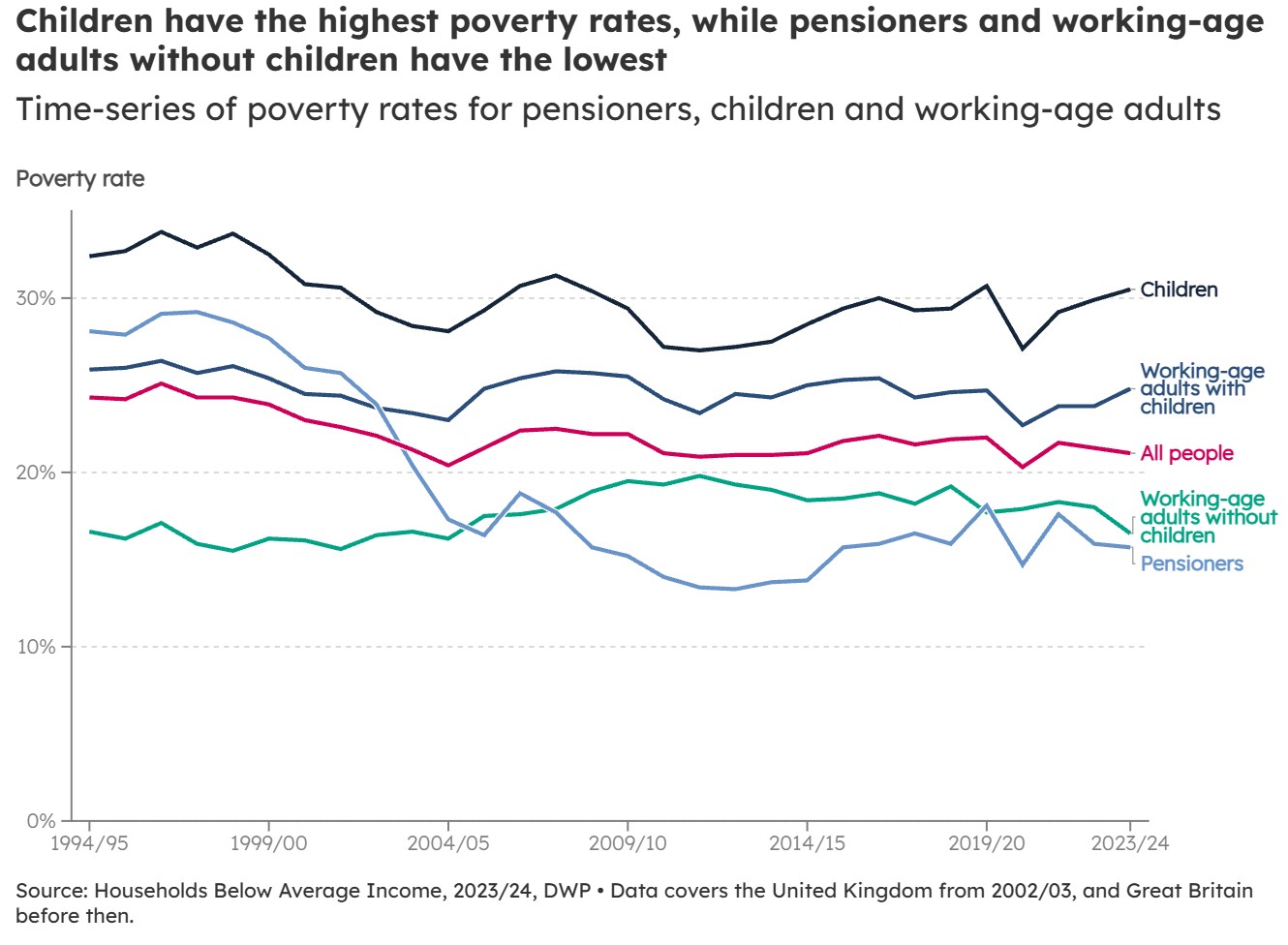
(source: DWP Via JRF.org)
Soft Long-termism shows that resources should be allocated to those activities that benefit the future as well as the present as these activities will bring about the greatest utility and most efficient use of capital. On the basis of this, LWPI supports a re-evaluation of public spending in the UK. Public resources and taxes should be aimed at maximising utility, stability and public goods into the future. At present, due largely to the triple-lock, large amounts of public money which could be doing immense good if properly allocated, is being spend to further enrich pensioners who make very little use of this money. Because of different spending patterns, the re-distribution of wealth away from younger working age people, upwards towards pensioners, is anathema to growth and economic prosperity. Reducing NI contributions would enable working people to stimulate the economy by spending more. This is the least impactful consequence of the UK’s redistribution of wealth upwards. Since 1995 pensioner poverty has dropped from 28.1% to 15.7% in 2024. This is in no small part due to the fiscally unsustainable triple-lock which continues to enrich pensioners at the expense not only of taxpayers but the whole economy. Pensioners are now the least impoverished demographic, meanwhile child poverty has remained relatively stable at 32.4%in 1995 to 30.5% in 2024. If only children could aggressively vote and kick up undue panic at the suggestion of altering their fiscally unviable redistribution mechanism.
The triple-lock hoovers wealth into one of the most economically inactive demographics. Current fiscal policy allocates resources away from the most economically active who have the greatest time horizon for investments. Allocate a 20-year-old a £10,000 grant and you may generate untold volumes of economic growth. Even if most entrepreneurs fail, one does not need to produce the next Steve Jobs to produce vastly greater marginal utility than redistributing this wealth upwards where it will do almost nothing to stimulate or grow the economy. A 20 year old with a grant will likely stimulate the economy while attempting to start a business, even if unsuccessful, and if she is successful, even in establishing a small, not particularly innovative business, she nevertheless grows the economy and provides greater job opportunities and economic activity through this. Soft long-termism clearly shows that resources should be allocated to some of the youngest in society as these individuals have the greatest time horizons to do the greatest good. Investment in education and child welfare is imperative because of the prospects of huge economic growth which stem from greater allocation of resources to children’s development and education. Ignoring the moral stain that is almost one third of children living in poverty, greater investment in them brings valuable outcomes both qualitatively for the child and those around them aswell as quantitatively in terms of goods generated into the future and harms avoided by raising a child out of poverty. Greater investment in youth resources can prevent the adult social care costs being incurred later in life if those issues can be addressed early on. The value of changing a single individual’s path from a lifetime of social service use to a life of stable employment is immense both in terms of the quality of life and fulfilment that individual has and in terms of the quantitative cost of avoiding social services expenditure and providing valuable labour to grow the economy. The LWPI is gravely concerned with the Governments policy of fiscal self-harm, flattening the economy and reducing growth, all to ensure the most inactive and least impoverished among us can continue to acquire wealth at the expense of working age tax payers.
Soft long-termism also directs care for the environment from a rational economic standpoint. Increased frequency and magnitude of environmental disasters will harm the global economy in huge ways. The United Kingdom is not only tied up in this global economy and will suffer along with other nations which experience more drastic climate harms but we will also suffer our own costly harms. As temperatures continue to rise it is highly likely we will require huge expenditures on the installation and annual running of air-conditioning systems. As well as increased disruption to infrastructure including roads and rail through increasing frequency of both flooding and damaging temperatures. Over time each of these costs will cumulatively cost the country billions. The cost of swapping to more environmentally conscious resources, materials and energy sources is comparatively tiny. Soft long-termism as a framework sharpens our focus on the long term harms we can avoid and goods we can bring about through policy. It highlights the importance of ensuring adequate resources for the future, the rational and just distribution of resources towards those who will bring about the greatest utility into the future, and prompts us to consider the consequences of our actions into the far future to prevent the worst harms and bring about the most effective outcomes through the most efficient means.
Importantly the LWPI does not embrace hard long-termism that weights the future and the present neutrally thus granting Much more moral consideration to long-term future people’s wellbeing over those in the present because there will be many more people living much farther into the future than in the present. LWPI rejects hard long-termism on grounds that it is far too quantitative and technical and thus does not grant sufficient consideration to qualitative features of morality in the lives of present people. Furthermore, hard long-termism is not suited to the structures of government the LPWI works within. This is not an over-arching critique of hard long-termism but rather a stance that it is not appropriate for the institute’s purpose.